
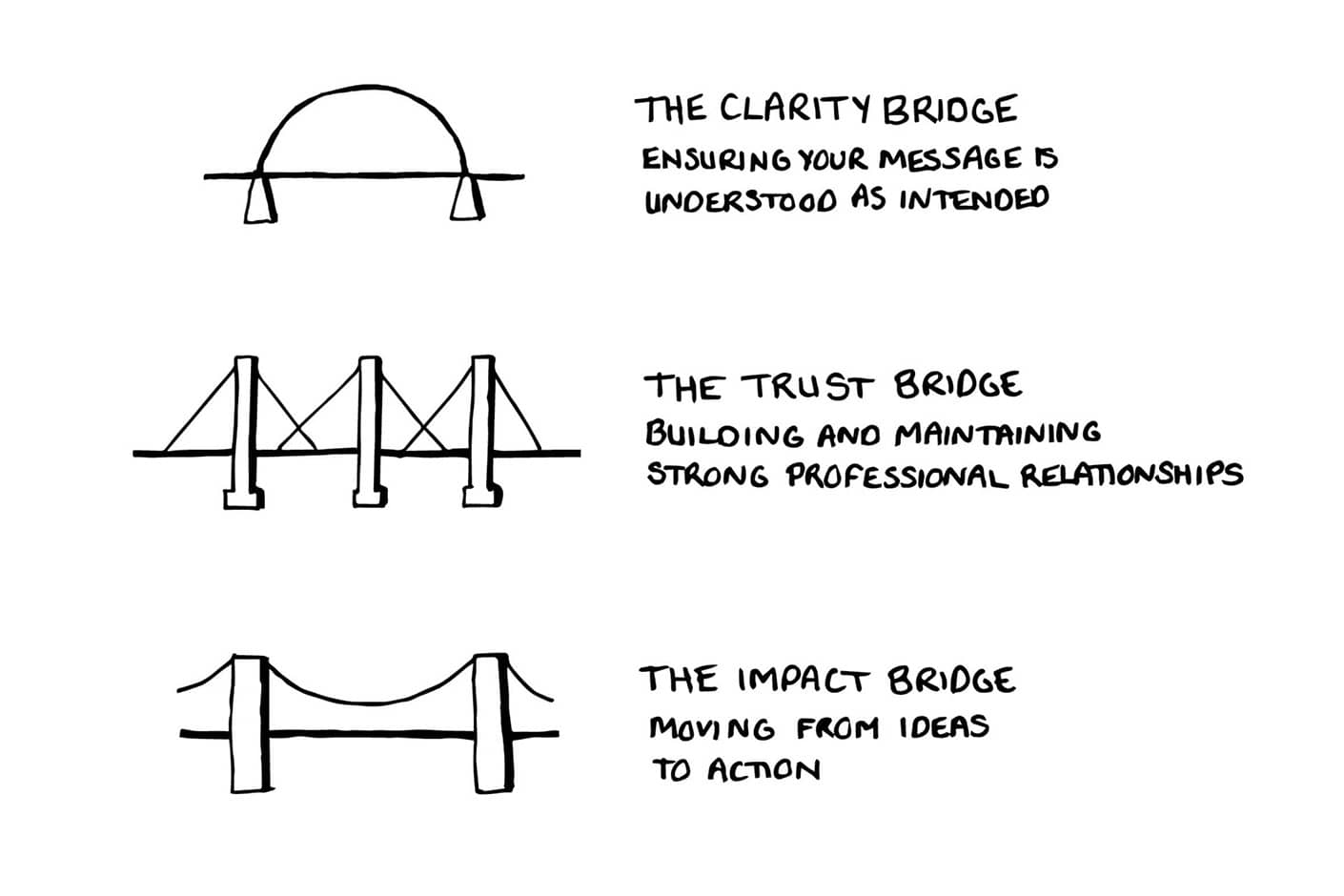
Three Bridges of Skilled Communication
Communication in leadership is not a nice-to-have extra. It is structural. It shapes understanding, direction, psychological safety, and the pace at which organisations move. In Balancing Act, Skilled Communication is one of the three Calibration Tools precisely because it governs how ideas, expectations, and emotions travel between people.
The book introduces the Three Bridges of Professional Communication:
- Clarity
- Trust
- Impact
As the underlying architecture that sits beneath every conversation, email, presentation, or message.
Language doesn’t transfer meaning directly - it sends signals that others interpret through their own experiences and emotional state.
Working with the three bridges helps ensure your intention survives that journey.
The Internal Bridge (Clarity): From Thought to Expression
Before words leave your mouth or your keyboard, they pass through your internal landscape: emotion, assumptions, bias, and the level of clarity you have about what you want to achieve.
In the book, the Clarity Bridge is supported by tools like the CLEAR framework and decision lenses for communication. You are encouraged to start with questions such as:
- What is the real purpose of this message?
- What outcome do I want, in behaviour or understanding?
- What emotional tone do I want to set or protect?
When leaders skip this, messages leak frustration, anxiety, or ambiguity, even when the content is correct.
The Relational Bridge (Trust): Connection Before Content
Communication is relational long before it is informational. The Trust Bridge is about psychological safety, emotional presence, and the history between you and the person or group you’re speaking with.
In Chapter 4, you explore how trust is formed through consistent behaviour, honest feedback, and how you handle difficult conversations. The stories from contributors such as Anne McClean and Adam Burgess show how shifts in language can reduce anxiety, build confidence, and reframe pressure scenarios.
When this bridge is strong, people can absorb challenging messages without shutting down. When it is weak, even neutral statements can feel sharp.
The External Bridge (Impact): Meaning in Context
The Impact Bridge deals with environment: organisational dynamics, communication channels, time pressure, and wider culture. Chapter 4 offers a practical Impact Bridge framework with four elements: actionable direction, momentum builders, engagement design, and results visibility.
For example:
- Translating “We need to digitise” into “Each team will identify three processes to digitise this quarter with plans due by 15 March”
- Creating simple progress showcases that keep initiatives moving
- Tailoring messages to different stakeholder groups rather than relying on one generic announcement
When the external bridge is strong, communication does more than inform; it produces aligned action.
When All Three Bridges Align
Skilled communication happens when:
- Your internal state is regulated and clear
- The relational space feels reasonably safe
- The context has been considered and designed for
This doesn’t require perfection in every conversation. It calls for awareness and small, deliberate adjustments that dramatically increase the chance your message lands as intended.
Putting the Three Bridges Into Practice
Choose one current piece of communication, for example, an upcoming briefing, a performance conversation, or a message you need to deliver about change.
- Internal: Write down your actual intention in one sentence. If it includes your own fears or frustrations, name them privately before you speak.
- Relational: Ask, “What does this person or group need to feel safe enough to hear me?”
- External: Decide where and how this message is best delivered *email, call, in-person, one-to-one, or group for example).
If you want a step-by-step guide, Balancing Act dedicates a full chapter to Skilled Communication, including practical templates, reflection questions, and real-world examples of the three bridges in action across digital, in-person, and high-pressure contexts.